
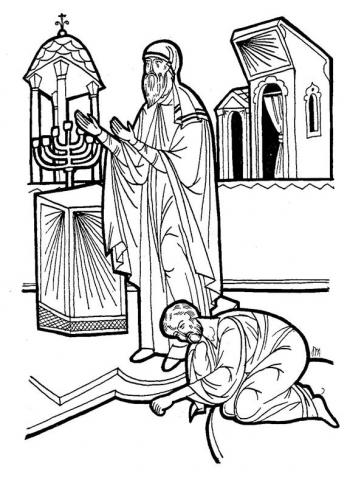
Luke 18:10-14
[9: Jesus also told this parable to some who trusted in themselves that they were righteous and despised others.] The Lord said this parable, “Two men went up into the temple to pray, one a Pharisee and the other a tax collector. The Pharisee stood and prayed thus with himself, ‘God, I thank you that I am not like other men, extortioners, unjust, adulterers, or even like this tax collector. I fast twice a week, I give tithes of all that I get.’ But the tax collector, standing far off, would not even lift up his eyes to heaven, but beat his breast, saying, ‘God, be merciful to me a sinner!’ I tell you, this man went down to his house justified rather than the other; for everyone who exalts himself will be humbled, but he who humbles himself will be exalted.”
Today marks the first day the Church asks us to begin our preparation for Great Lent. She prepares us through the four Gospels read at the Divine Liturgy each Sunday preceding the first day of Great Lent. These Gospels set the tone for hymns sung during the following week’s services beginning with last evening. The four gospel readings also provide a framework for our spiritual life, offering guidance on how to conduct ourselves during Great Lent and throughout our lives as Christians.
In today’s Gospel reading Jesus instructs us through his well known parable of the Publican and the Pharisee: Two men are praying in the Temple. One man, the Pharisee—a follower of the sect of the contemporary Judaism whose adherents strictly followed the teachings of the Law—praises himself for his faithfulness to certain rituals to rectify himself with God, while at the same time he acclaims his life for not being like those whose public lives and acts are counter to the ways of God. Meanwhile the other man, a publican or toll-collector, whose profession violated certain Jewish tenants, contrasts the first man and simply prays over and over: “God be merciful to me a sinner.” Our Lord then summarizes the meaning of this parable: “for everyone who exalts himself will be humbled, but he who humbles himself will be exalted.”
Next week we will learn about God’s everlasting love for those who repent from their ways in Jesus’s parable of the Prodigal Son (Luke 15:11-32). The following Sunday we will hear why we need to and how to rectify our relationship with God in the Parable of the Last Judgment (Matthew 25:31-46). And finally on the last Sunday before Lent we learn from our Lord Himself how we are to pray and fast—those tools that aid us to repent—return to the path set by the Lord (Matthew 6:14-21).
Today’s Gospel establishes a foundational perspective on our relationship with God, as exemplified by the prayer of the Publican. The Publican offered to God a simple prayer: “God be merciful to me a sinner.” These words are so essential to our lives in Christ that, in many editions of our prayer books, they constitute the first prayer we are instructed to recite upon waking. In these few words, we acknowledge our relationship with God and understand Him as our heavenly father and creator. We admit our broken relationship with Him. We recognize that we sin because through our wayward selfish acts we ultimately fail to fulfill our purpose to what we are called. By addressing God as sinners, we reopen ourselves to His merciful love and accept the consequences of our actions—God’s justice.
The parable’s meaning is not a new teaching from Jesus but is echoed throughout Scripture, particularly in Psalms and the writings of Amos (see chapters 4 and 5) and Ezekiel (chapter 33). These prophets urged the people of Israel and Judah, and in due course us, to turn from their “crooked ways” and focus on the vulnerable—the widows, orphans, and needy—rather than exclusively on the ritual duties in order to rectify one’s self with God. We hear this message in Psalm 50/51*, recited during many services and in our daily prayers: the prayer of repentance par excellence which begins: “Have mercy on me, O God, according to Thy great mercy; according to the multitude of Thy tender mercies, blot out my transgressions.”
At another time Jesus spoke about this in a different manner regarding those who outwardly appear righteous to men, but inside are full of hypocrisy and lawlessness…. For they pay tithe of mint and anise, and cummin and have neglected the weightier matters of the law: justice and mercy and faith. These they ought to have done, without leaving the others undone (Matthew 23).
Jesus instructs us that the fault of the Pharisee in the parable was in his exaltation of what he considered his state of rectification with God in contrast to others. He ought to have had mercy on his fellow many while still following the other commandments of God. As Saint Luke writes: “Jesus told this parable to some who trusted in themselves that they were righteous and despised others” (Luke 18:9).
Thus, we are first to focus on and repair our broken relationship with God, and then, just as God has mercy on us, we are then to have compassion on the other: to love our neighbor as ourselves, to forgive him as Christ says seven times, and not to judge him—that is for the Lord’s privilege alone. And so brothers and sisters may we make this hymn from today’s matin service our directive for this week as we begin that journey to Pascha, the feast of eternal Life: Let us all humble ourselves, brethren; groaning and lamenting, let us beat our conscience, that at the eternal judgement we may be numbered with the faithful and the righteous, receiving forgiveness. Let us pray to see the true peace of the Age to Come, where there is no more pain, no sorrow, no groaning from the depths, in the wondrous Eden fashioned by Christ, for He is God co-eternal with the Father (Oikos of the Kontakion for the Sunday of the Publican and the Pharisee).

