
Matthew 8:28–9:1; Romans 10:8–10
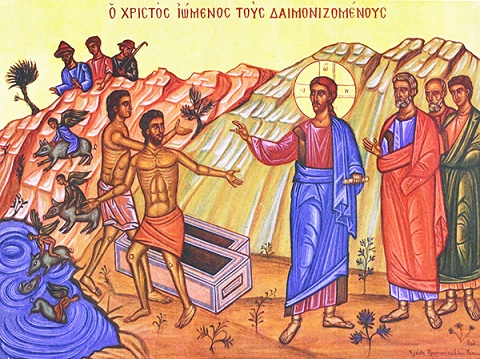
At that time, when Jesus came to the country of the Gergesenes, two demoniacs met him, coming out of the tombs, so fierce that no one would pass that way. And behold, they cried out, “What have you to do with us, O Son of God? Have you come here to torment us before the time?” Now a herd of many swine was feeding at some distance from them. And the demons begged him, “If you cast us out, send us away into the herd of swine.” And he said to them, “Go.” So they came out and went into the swine; and behold, the whole herd rushed down the steep bank into the sea, and perished in the waters. The herdsmen fled, and going into the city they told everything, and what had happened to the demoniacs. And behold, all the city came out to meet Jesus; and when they saw him, they begged him to leave their neighborhood. And getting into a boat he crossed over and came to his own city.
There is something beautiful about the moment Jesus steps onto the shore of the Gergesenes. He arrives not to applause, not to welcome, but to a confrontation with the very forces that torment humanity. Two men—violent, isolated, living among tombs—rush toward Him. They are the picture of what darkness does to a soul: it isolates, dehumanizes, and buries a person long before death ever comes. Yet Jesus does not flinch.
The demons recognize Him instantly. They know His name, His authority, His future judgment. It is striking that the powers of darkness have a clearer grasp of who Jesus is than many who claim to walk in the light. But recognition is not the same as surrender. They know Him, but they do not love Him. They acknowledge Him, but they do not trust Him. Their confession is one of fear, not faith.
Jesus speaks only one word—“Go”—and the chains that held these men for years fall away in an instant. No ritual. No struggle. No negotiation. Just the effortless authority of the Son of God. The men are freed, restored, returned to themselves. The darkness that once ruled them is drowned and gone. But the town responds with fear. They see the cost of deliverance—the loss of the herd—and they ask Jesus to leave.
It is one of the saddest moments in the Gospels: the Savior stands before them, the One who can heal, restore, and redeem, and they choose comfort over transformation. They choose the familiar over the divine. They choose the swine over the Savior. And Jesus leaves. Yet He does not leave without a witness. The delivered men remain—living testimonies of His power, reminders that even in places that reject Him, His grace has already broken through.
Today’s epistle from St. Paul to the shines a light on this moment. Paul tells us that salvation is near—“in your mouth and in your heart.” It is not distant, not complicated, not reserved for the worthy. It is as close as confession and belief. But it must be personal. The demons confessed Jesus’ identity, but they did not bow. The townspeople saw His authority, but they did not welcome Him. Deliverance happened in their midst, but salvation requires a heart and a life that trusts in the power of His resurrection.
The men freed from darkness experienced Jesus’ authority, but St. Paul’s teaching from Romans reminds us that true salvation is not merely being rescued from what binds us—it is entering into relationship with the One who rescues. It is believing in the heart and confessing with the mouth. It is choosing the presence of Christ over the comfort of the familiar. The Gospel of St. Matthew shows us Jesus’ power. St. Paul shows us how that power becomes ours. And together they ask a quiet, searching question: When Jesus steps onto the shores of our lives—disrupting, confronting, freeing—will we ask Him to leave, or will we confess Him as Lord?

