
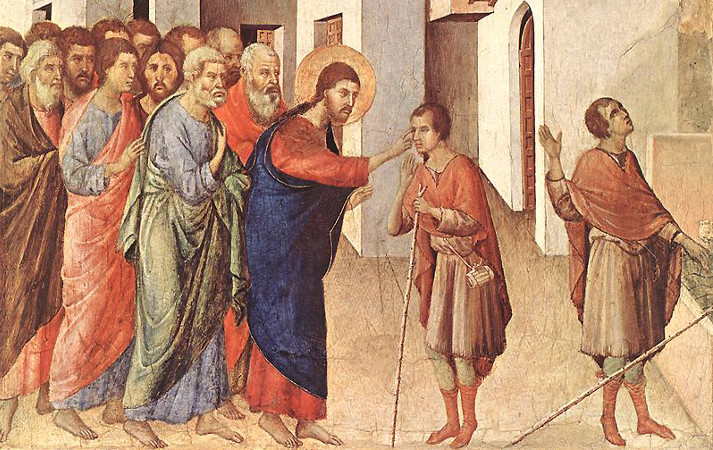
Matthew 9:27–35; Seventh Sunday after Pentecost:
And as Jesus passed on from there, two blind men followed him, crying aloud, “Have mercy on us, Son of David.” When he entered the house, the blind men came to him, and Jesus said to them, “Do you believe that I am able to do this?” They said to him, “Yes, Lord.” Then he touched their eyes, saying, “According to your faith be it done to you.” And their eyes were opened. And Jesus sternly charged them, “See that no one knows it.” But they went away and spread his fame through all that district. As they were going away, behold, a dumb demoniac was brought to him. And when the demon had been cast out, the dumb man spoke; and the crowds marveled, saying, “Neer was anything like this seen in Israel.” But the Pharisees said, “He casts out demons by the prince of demons.” And Jesus went about all the cities and villages, teaching in their synagogues and preaching the gospel of the kingdom, and healing every disease and every infirmity.
The Gospel shows us two blind men following Jesus, calling out into the darkness that surrounds them. They cannot see Him, yet they trust Him. They walk without sight, yet they cling to the One who is Himself the Light. Their cry—“Son of David, have mercy on us”—is the prayer of every heart that longs for healing but does not yet see the way forward.
When Jesus asks, “Do you believe that I am able to do this?” He is not asking for certainty. He is asking for trust. And their simple answer—“Yes, Lord”—opens their eyes.
But the One who restores their sight is walking toward a deeper mystery. The hands that touch them will soon be stretched upon the cross. The eyes that look upon them with compassion will close in death. The voice that speaks mercy will fall silent in the tomb.
Every healing in this passage is a sign pointing forward—to the cross where Christ takes upon Himself the wounds of the world, and to the resurrection where He transforms them. The blind see, the mute speak, the broken are restored—not only because Jesus is powerful, but because He is the One Lord, Son of God—True God of True God–who will carry human suffering into His own body and rise with it made new.
St. Matthew tells us that Jesus is moved with compassion because the people are “weary and scattered.” That compassion is not a passing feeling. It is the very reason He goes to the cross. It is the love that refuses to leave humanity lost. It is the mercy that descends into death so that no darkness can ever be final.
In the crucified Christ, we see God entering our pain. In the risen Christ, we see God transforming it. And so His question comes to us as well: “*Do you believe I am able to do this?” Do you believe I am able to bring light into your shadows, hope into your weariness, and new life into the places that feel closed and silent?
Hope does not mean we see clearly. Hope means we trust the One who has already gone through death and risen. Like the blind men, we follow Him even when the path is dim. Like the mute man, we find our voice restored by His mercy. Like the crowds, we stand in astonishment at grace. And like the weary sheep, we are gathered by the Shepherd who laid down His life and took it up again.
May our hearts answer Him with the same quiet courage: Yes, Lord. And may His risen light open our eyes to the nearness of His compassion.

