
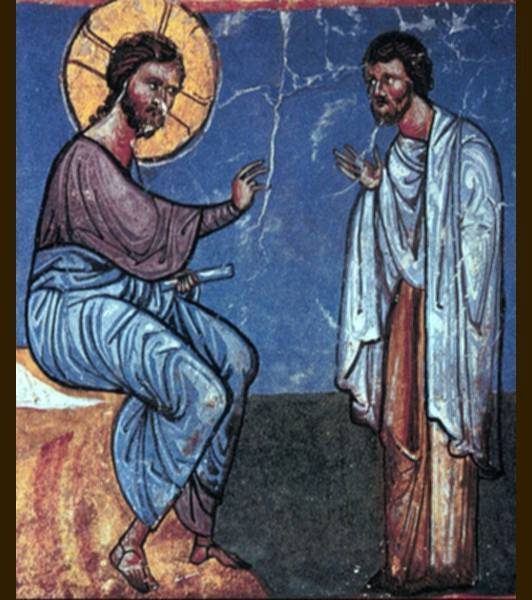
Twelfth Sunday of Matthew 19:16–26 and 1 Corinthians 15:1–11
Brethren, I would remind you in what terms I preached to you the gospel, which you received, in which you stand, by which you are saved, if you hold it fast — unless you believed in vain. For I delivered to you as of first importance what I also received, that Christ died for our sins in accordance with the scriptures, that he was buried, that he was raised on the third day in accordance with the scriptures, and that he appeared to Cephas, then to the twelve. Then he appeared to more than five hundred brethren at one time, most of whom are still alive, though some have fallen asleep. Then he appeared to James, then to all the apostles. Last of all, as to one untimely born, he appeared also to me. For I am the least of the apostles, unfit to be called an apostle, because I persecuted the church of God. But by the grace of God I am what I am, and his grace toward me was not in vain. On the contrary, I worked harder than any of them, though it was not I, but the grace of God which is with me. Whether then it was I or they, so we preach and so you believed.
At that time, a young man came up to Jesus, kneeling and saying, “Good Teacher, what good deed must I do, to have eternal life?” And he said to him, “Why do you call me good? One there is who is good. If you would enter life, keep the commandments.” He said to him, “Which?” And Jesus said, “You shall not kill, You shall not commit adultery, You shall not steal, You shall not bear false witness, Honor your father and mother, and You shall love your neighbor as yourself.” The young man said to him, “All these I have observed; what do I still lack?” Jesus said to him, “If you would be perfect, go, sell what you possess and give to the poor, and you will have treasure in heaven; and come, follow me.” When the young man heard this he went away sorrowful; for he had great possessions.
And Jesus said to his disciples, “Truly, I say to you, it will be hard for a rich man to enter the kingdom of heaven. Again I tell you, it is easier for a camel to go through the eye of a needle than for a rich man to enter the kingdom of God.” When the disciples heard this they were greatly astonished, saying, “Who then can be saved?” But Jesus looked at them and said to them, “With men this is impossible, but with God all things are possible.”
There is a moment in the Gospel when a young man, earnest and searching, comes to Christ with the question that has lived in every human heart: “What good thing shall I do to inherit eternal life?” He is sincere. He is devout. He has kept the commandments. Yet something in him knows that goodness—his goodness—is not enough. There is still a hunger, a restlessness, a sense that the life he longs for lies just beyond his reach.
Jesus does not dismiss his desire. Instead, He gently exposes the hidden assumption beneath the question: that eternal life is a matter of human achievement, that salvation is a project we can complete if only we find the right task. The Lord’s final invitation—“Sell what you have… and follow Me”—is not a demand for poverty but a call to release the illusion of self‑sufficiency. The young man’s sorrow reveals how tightly he clings to the belief that he must be the architect of his own salvation.
And then Jesus speaks the words that shatter every spiritual illusion: “With men this is impossible, but with God all things are possible.”
In today’s epistle St. Paul, writing to the Corinthians, stands as the living witness to this truth. He knows what it is to rely on one’s own righteousness, one’s own zeal, one’s own accomplishments. But he also knows what it is to be undone by grace. In his confession—“By the grace of God I am what I am”—Paul offers the answer the rich young man could not yet receive. Salvation is not the reward for the worthy; it is the gift given to the unworthy. It is not the triumph of human effort but the victory of Christ’s death and resurrection.
St. Paul’s life becomes the mirror in which the Gospel is understood: Christ died. Christ was buried. Christ rose. Christ appeared. And Paul received this—not achieved it, not earned it, but received it—and it became the ground on which he stands.
The rich young man walked away sorrowful because he could not imagine a life built on grace. Paul walked forward in joy because grace had remade him.
So the reflection for us is simple and searching: Where do we still cling to the belief that we must save ourselves? Where do we imagine that eternal life depends on our goodness, our discipline, our accomplishments? And where is Christ inviting us to release these burdens and follow Him into the freedom of grace?
For what is impossible for us has already been accomplished by Him. We do not become worthy and then receive salvation. We receive salvation, and grace makes us what we could never make ourselves.

