
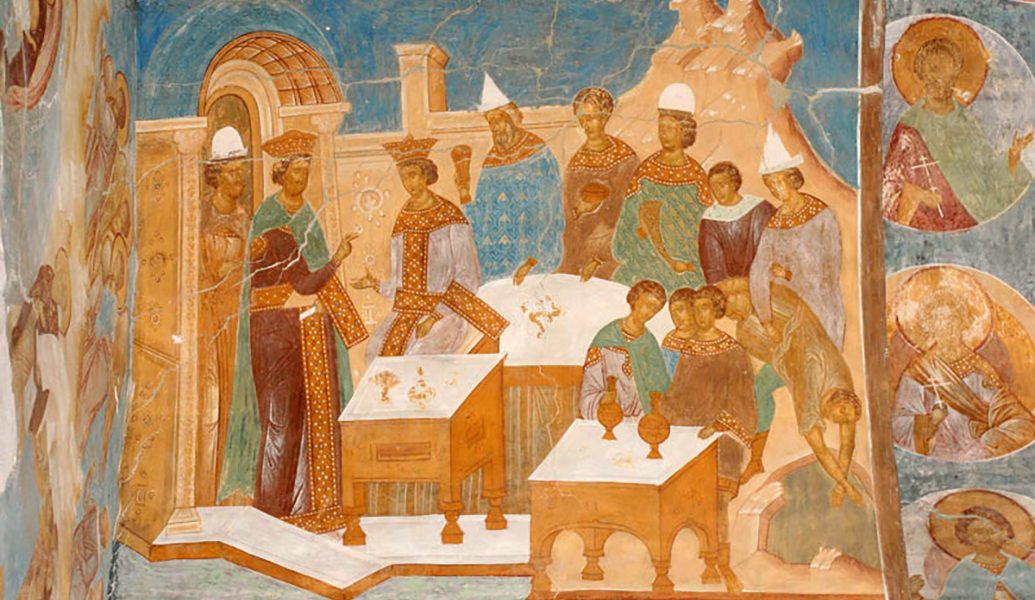
Fourteenth Sunday of Matthew: 22:2–14
The Lord said this parable, “The kingdom of heaven may be compared to a king who gave a marriage feast for his son, and sent his servants to call those who were invited to the marriage feast; but they would not come. Again he sent other servants, saying, ‘Tell those who are invited, Behold, I have made ready my dinner, my oxen and my fat calves are killed, and everything is ready; come to the marriage feast.’ But they made light of it and went off, one to his farm, another to his business, while the rest seized his servants, treated them shamefully, and killed them. The king was angry, and he sent his troops and destroyed those murderers and burned their city. Then he said to his servants, ‘The wedding is ready, but those invited were not worthy. Go therefore to the thoroughfares, and invite to the marriage feast as many as you find.’ And those servants went out into the streets and gathered all whom they found, both bad and good; so the wedding hall was filled with guests.
But when the king came in to look at the guests, he saw there a man who had no wedding garment; and he said to him, ‘Friend, how did you get in here without a wedding garment?’ And he was speechless. Then the king said to the attendants, ‘Bind him hand and foot, and cast him into the outer darkness; there men will weep and gnash their teeth.’ For many are called, but few are chosen.”
The Kingdom of God is described as a wedding feast—a celebration already prepared, already overflowing with joy, already waiting for guests. In Christ’s parable, nothing is lacking on God’s side. The table is set, the lamps are lit, the doors stand open. The invitation goes out again and again. Yet the tragedy of the story is not hostility, but indifference. Those first invited “made light of it,” turning back to their fields and their businesses, absorbed in the ordinary rhythms of life.
Recall the hymns of Holy Week that confront us with this same danger. The Bridegroom comes, not with thunder, but quietly, “in the middle of the night,” when hearts are drowsy and attention is thin. The hymns plead with us: “My soul, do not be weighed down with sleep.” They remind us that spiritual slumber is not dramatic rebellion—it is distraction, preoccupation, the slow drift of the heart away from the One who calls.
And yet the king in the parable does not give up. He sends his servants into the streets, gathering “both good and bad.” This is the mercy of God: the invitation is universal, the doors are wide, the feast is for everyone. But the parable turns sharply when the king sees a man without a wedding garment. The hall is full of sinners and saints alike, yet only one is speechless—only one has come without being changed. The man without a wedding garment.
The wedding garment is not about moral perfection. It is not about being “good enough.” It is the garment of repentance, the clothing of a heart willing to be transformed. Bridegroom Matins gives us the words: “I see Thy bridal chamber adorned, O my Savior, but I have no wedding garment that I may enter.” This is not despair—it is the beginning of true preparation. It is the humility that allows Christ to clothe us in His own light.
The garment is Christ Himself. It is the life of mercy, the willingness to forgive, the quiet turning of the heart toward God. It is the watchfulness that refuses to sleep through the visitation of grace. It is the courage to let the Gospel reshape our priorities, our habits, our desires.
The man without the garment is silent because he has no relationship with the Bridegroom. He accepted the invitation but resisted the transformation. He came to the feast but did not prepare his heart. The parable warns us that it is possible to be present in the Church and yet absent in spirit—to hear the Gospel but remain unchanged.
We hear in the baptismal service and at Holy Week the Church’s cry: Let yourself be clothed. Let Christ weave the garment of repentance around your soul. Let the Bridegroom find you awake, attentive, and ready. The feast is prepared. The doors are open. The Bridegroom is near.
May we enter His joy wearing the garment He freely gives—the garment of a heart made new.

