
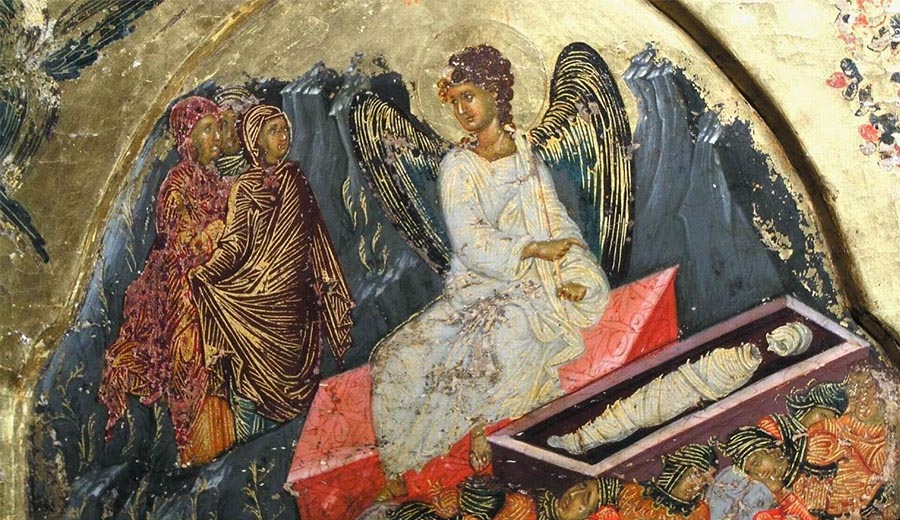
Sunday of the Myrrhbearing Women
We often hear the word gospel, but do we stop to ask what the “good news” actually is? St. Paul answers this directly when he reminds the Corinthian community of the message he first preached to them—what he calls “of first importance”:
– Christ died for our sins according to the Scriptures,
– He was buried,
– He was raised on the third day according to the Scriptures,
– He appeared to Peter, then to the Twelve.
Today’s Gospel reading from St. Mark echoes this same proclamation. After the crucifixion, the women who had followed Jesus—Mary Magdalene, Mary the mother of James, and Salome—saw where His body was laid. After the Sabbath they returned with spices to anoint Him. Instead, they found the stone rolled away, the tomb empty, and a young man in white announcing:
“You seek Jesus of Nazareth, who was crucified. He has risen; He is not here.”
The women fled in fear and amazement. Yet their encounter at the empty tomb is the beginning of Christian faith. St. Mark and St. Paul together show us what is fundamental: faith is our response to the good news of Christ’s death and resurrection.
The empty tomb confronts the Myrrhbearing Women with a call to trust: trust that Jesus—whom they followed, who spoke of God as Father, who obeyed even unto death—has been vindicated by God. His resurrection overturns the judgment of the world and reveals Him as God’s Anointed.
This was foretold in Scripture: “Through the knowledge of God’s will shall the righteous one, my servant, make many to be accounted righteous.”
Faith, then, is not a human achievement. It is a response to a gift—a discovery that changes one’s entire life. It comes unexpectedly, like the women’s astonishment at the tomb. It is a trust surprised at itself.
St. Mark tells us the women were afraid. But the story does not end in fear.
The entire mission of Christ and His Father can be summed up in one word: love.
When love casts out fear, even death—the thing we fear most—becomes not the end of hope but the doorway into deeper communion with God. The resurrection reveals a Life stronger than death, freeing us to see dying itself as an act of self-giving love, entrusted to God.
St. Paul tells the Romans: “Christ was raised from the dead by the glory of the Father… death no longer has dominion over Him.”
And he adds the promise for us: “If we have been united with Him in a death like His, we shall certainly be united with Him in a resurrection like His.”
The Myrrhbearing Women fulfilled the angel’s command. Out of love, they proclaimed the resurrection. Their trust became testimony.
The Book of Acts shows that some came to faith through miracles or direct encounters with the risen Christ. But many more believed simply through the witness of others—through the spoken word of ordinary men and women. On Pentecost, thousands were baptized because they trusted St. Peter’s proclamation. The Ethiopian eunuch believed through St. Philip’s explanation. The Athenians heard St. Paul and responded.
Whether through a divine manifestation or through human speech, the result is the same: faith comes by hearing the good news.
The women’s message echoes Prophet Isaiah’s cry to the redeemed:
“Behold your God!
Receive from us the glad tidings of Christ’s Resurrection!”
Their trust invites our trust. Their witness calls forth our witness.
The gospel, St. Paul says, is “the power of God for salvation to everyone who has faith.” So let us imitate these women—steadfast in love, courageous in trust, and bold in proclaiming the good news by word and deed. With conviction and hope, let us announce the message that changed the world: Christ is risen.

