
Matthew 17:14–23, in the light of Matthew 17:1–9–Tenth Sunday of Matthew
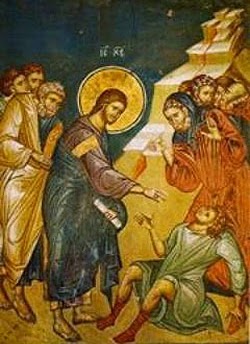
At that time, a man came up to Jesus and kneeling before him said, “Lord, have mercy on my son, for he is an epileptic and he suffers terribly; for often he falls into the fire, and often into the water. And I brought him to your disciples, and they could not heal him.” And Jesus answered, “O faithless and perverse generation, how long am I to be with you? How long am I to bear with you? Bring him here to me.” And Jesus rebuked him, and the demon came out of him, and the boy was cured instantly. Then the disciples came to Jesus privately and said, “Why could we not cast it out?” He said to them, “Because of your little faith. For truly I say to you, if you have faith as a grain of mustard seed, you will say to this mountain, ‘Move hence to yonder place,’ and it will move; and nothing will be impossible to you. But this kind never comes out except by prayer and fasting.” As they were gathering in Galilee, Jesus said to them, “The Son of man is to be delivered into the hands of men, and they will kill him, and he will be raised on the third day.”
The mountain still clings to them. The brightness of Christ’s face, the shimmering garments, the voice that rolled like thunder from the cloud—these things are not easily forgotten. Peter, James, and John descend with Jesus carrying a secret glory in their hearts, a glimpse of the world as it truly is when seen in God’s light. But the valley waits for them.
And in the valley stands a father with a broken voice and a suffering child. The disciples, still dazzled by the memory of divine radiance, find themselves powerless before human pain. The contrast is jarring: from the summit of revelation to the raw ache of a parent begging for help.
Jesus steps into the scene with the same calm authority He carried on the mountain. The glory has not faded; it has simply taken on a different form. On the mountain, it shone like the sun. In the valley, it bends low in compassion.
The father’s plea is simple: “Lord, have mercy.” It is the same cry that echoes through every human valley—every hospital room, every sleepless night, every moment when love feels helpless. Jesus answers not with frustration but with healing. The boy is restored. The father’s burden is lifted. The valley becomes, for a moment, a place of transfiguration too.
But then Jesus speaks of His own suffering—His betrayal, His death, His rising. The disciples, who had seen Him clothed in light, cannot bear the thought of Him clothed in sorrow. They are “greatly distressed,” because they do not yet understand that the glory of the mountain and the agony of the Cross are not opposites. They are one revelation.
The Transfiguration was not given to spare them from the valley. It was given so they could walk through the valley without fear. It showed them that the One who would be handed over to death is the same One whose face shines like the sun. It showed them that the path of suffering is not a detour from glory but the road by which glory enters the world.
And so the meditation turns toward us. We, too, have known mountains—moments of clarity, beauty, and peace when God feels near and faith feels easy. But we also know valleys—places where our strength fails, where our prayers feel thin, where we face needs we cannot fix.
Christ meets us in both. He does not ask us to choose between the mountain and the valley. He asks us to follow Him through both, trusting that the light we saw in prayer is the same light that guides us through sorrow. The glory that once shone around Him now shines through His compassion, His healing, His Cross.
And in every valley, He whispers the same words the Father spoke on the mountain: “This is My beloved Son… listen to Him.”

