
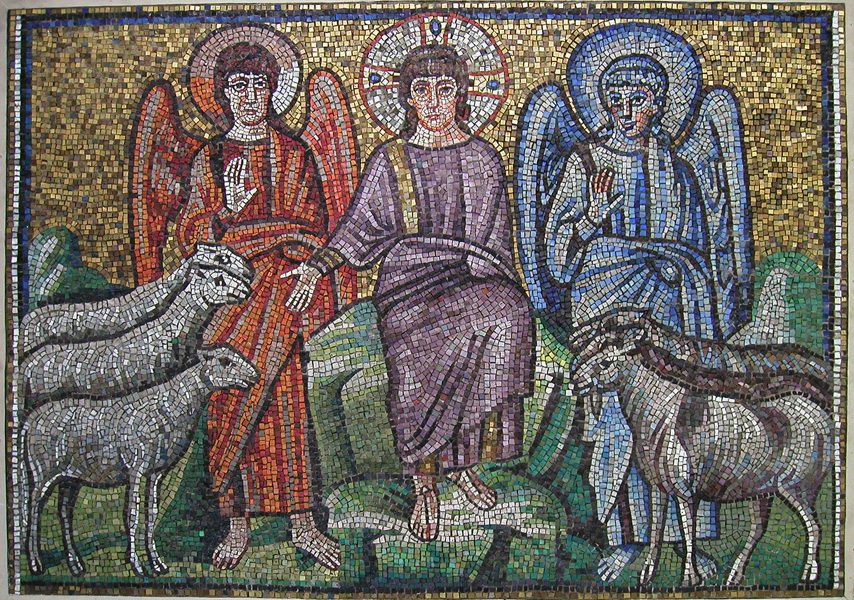
Matthew 25:31-46
The Lord said, “When the Son of man comes in his glory and all the holy angels with him, then he will sit on his glorious throne. Before him will be gathered all the nations, and he will separate them one from another as a shepherd separates the sheep from the goats, and he will place the sheep at his right hand, but the goats at the left. Then the king will say to those at his right hand, ‘Come, O blessed of my Father, inherit the kingdom prepared for you from the foundation of the world; for I was hungry and you gave me food, I was thirsty and you gave me drink, I was a stranger and you welcomed me, I was naked and you clothed me, I was sick and you visited me, I was in prison and you came to me.’ Then the righteous will answer him, ‘Lord, when did we see you hungry and feed you, or thirsty and give you drink? And when did we see you a stranger and welcome you, or naked and clothe you? And when did we see you sick or in prison and visit you?’ And the King will answer them, ‘Truly, I say to you, as you did it to one of the least of these my brethren, you did it to me.’ Then he will say to those at his left hand, ‘Depart from me, you cursed, into the eternal fire prepared for the devil and his angels; for I was hungry and you gave me no food, I was thirsty and you gave me no drink, I was a stranger and you did not welcome me, naked and you did not clothe me, sick and in prison and you did not visit me.’ Then they also will answer, ‘Lord, when did we see you hungry or thirsty or a stranger or naked or sick or in prison, and did not minister to you?’ Then he will answer them, ‘Truly, I say to you, as you did it not to one of the least of these, you did it not to me.’ And they will go away into eternal punishment, but the righteous into eternal life.’”
***
As I noted in my reflections on the previous two Sundays, these gospel readings, which lead us into Great Lent, show us how to build the foundation for our spiritual life—a life in which we who are baptized Christians, who have put on Christ, are to be his witnesses shining forth in the world.
From the Publican’s simple prayer—“God be merciful to me a sinner”—to the father’s joy at his lost son’s return, we learn that our lives should focus on repairing our relationship with God. When we repent we open ourselves to God’s mercy and accept the consequences of our actions. Today, we learn the importance of these consequences.
Today’s gospel reading from Saint Matthew gospel comes from Jesus’s final teachings to his disciples just before his trial, passion, and crucifixion. So, because of where the parable is located in Saint Matthew’s gospel it i bs crucial for our lives.
In the form of a parable, Jesus describes the final judgment of the nations. The Lord appears surrounded by angels and is seated on his royal throne. Before him are all the nations of the world, which he separates as a shepherd separates the sheep and the goats. The king invites those whom he divided on his right to inherit his heavenly kingdom and to those on his left to enter eternal punishment.
Each group asks: why this decision? The king answers that it was due to how they acted towards him who was really the least of their fellow man. Those who are to inherit the kingdom, fed the hungry, provided drink to the thirsty, welcomed the stranger, and visited the sick and the imprisoned. Those who are to receive eternal punishment neglected such acts towards their fellow man, in essence God.
The difficult lesson of this parable for us is that how we act towards our fellow man, particularly those who are suffering, the vulnerable, show how we act towards God.
As we learned last week in the Parable of the Prodigal Son, there are consequences to how we act. We also learned from the previous Sunday gospels that the prayer of repentance—that of the Publican and the Prodigal—is about re-opening ourselves to God’s merciful love (into which we are constantly invited). And the message from today’s gospel is that when we repent, we are to accept willingly the consequences of our actions—God’s justice.
God is both perfectly just and merciful. Without justice, God would be arbitrary; without love, God would be tyrannical. It is because of God’s perfect love and justice that we know in faith that the purpose to which we are called is the fulfillment of our nature.
Today’s gospel teaches us that we daily face the test of love, which as we hear is the measure by which we demonstrate our commitment to our Christian faith—our life in Christ, which began when Christ showed his love for us through his sacrificial death. Faith, our answer to God’s call, doesn’t secure our salvation unless it passes the test of love. As Saint Paul instructs the Galatians:
For you were called to freedom, brethren; only do not use your freedom as an opportunity for the flesh, but through love be servants of one another. For the whole law is fulfilled in one word, “You shall love your neighbor as yourself.” (Galatians 5:13-14)
Unlike the sheep and goats from the parable, we have been given the understanding of the measures by which we will be held accountable and the reasons why: how we treat others reflects how we act towards God. We should use the gift of time to change our ways now and act with love and mercy, emulating the compassion and kindness of our Lord and Creator.
Amen.
