
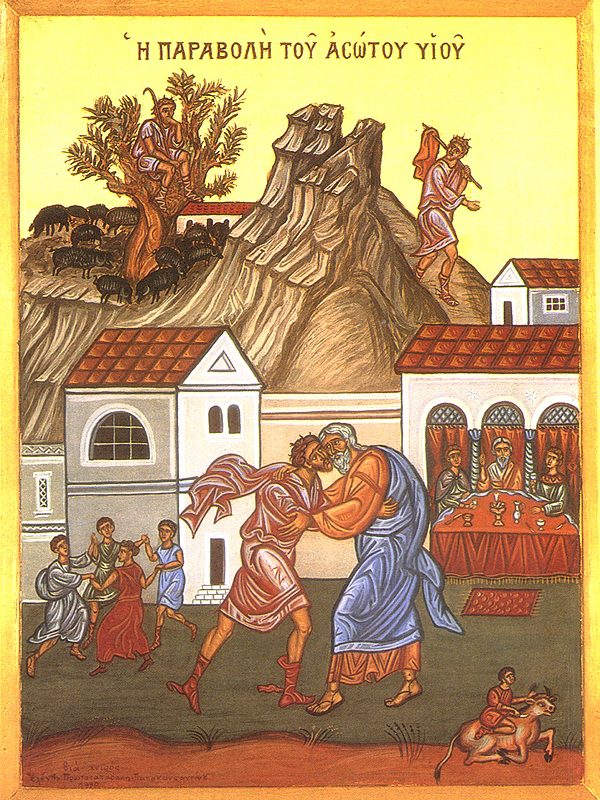
Luke 15:11-32
The Lord said this parable: “There was a man who had two sons; and the younger of them said to his father, ‘Father, give me the share of the property that falls to me.’ And he divided his living between them. Not many days later, the younger son gathered all he had and took his journey into a far country, and there he squandered his property in loose living. And when he had spent everything, a great famine arose in that country, and he began to be in want. So, he went and joined himself to one of the citizens of that country, who sent him into his fields to feed swine. And he would gladly have filled his belly with the pods that the swine ate; and no one gave him anything. But when he came to himself he said, ‘How many of my father’s hired servants have bread enough and to spare, but I perish here with hunger! I will arise and go to my father, and I will say to him, ‘Father, I have sinned against heaven and before you; I am no longer worthy to be called your son; treat me as one of your hired servants.’ And he arose and came to his father. But while he was yet at a distance, his father saw him and had compassion and ran and embraced him and kissed him. And the son said to him, ‘Father, I have sinned against heaven and before you; I am no longer worthy to be called your son.’ But the father said to his servants, ‘Bring quickly the best robe, and put it on him; and put a ring on his hand, and shoes on his feet; and bring the fatted calf and kill it, and let us eat and make merry; for this my son was dead, and is alive again; he was lost, and is found.’ And they began to make merry. Now his elder son was in the field; and as he came and drew near to the house, he heard music and dancing. And he called one of the servants and asked what this meant. And he said to him, ‘Your brother has come, and your father has killed the fatted calf, because he has received him safe and sound.’ But he was angry and refused to go in. His father came out and entreated him, but he answered his father, ‘Lo, these many years I have served you, and I never disobeyed your command; yet you never gave me a kid, that I might make merry with my friends. But when this son of yours came, who has devoured your living with harlots, you killed for him the fatted calf!’ And he said to him, ‘Son, you are always with me, and all that is mine is yours. It was fitting to make merry and be glad, for this your brother was dead, and is alive; he was lost, and is found.’”
***
Hymn from Matins
Our Savior teaches us every day with His own voice: let us therefore hearken to the Scriptures concerning the Prodigal who became wise once more, and with faith let us follow the good example of his repentance. With humbleness of heart let us cry out to Him who knows all secrets: We have sinned against Thee, merciful Father, and are not worthy ever again to be called Thy children as before. But since Thou art by nature full of love for man, accept me and make me as one of Thy hired servants (Oikos of the Kontakion).
***
As I noted last Sunday, the four gospel readings for the Sundays before Great Lent provide a framework for our spiritual life: they guide us how to conduct ourselves during Lent and throughout our lives as Christians.
Today’s gospel, the Parable of the Prodigal Son, highlights God’s welcoming love for those who repent.
The younger of two sons formally requests his portion of his father’s estate. After his father grants this request, he squanders his funds through “loose living.” Desperate and hungry, the son, now working as a herder of swine, “comes to himself” and decides to return to his father to serve as one of his hired hands. Yet he recognizes that he must acknowledge his sinful acts against his father.
But when he came to himself, he said, “How many of my father’s hired servants have bread enough and to spare, but I perish here with hunger! I will arise and go to my father, and I will say to him, ‘Father, I have sinned against heaven and before you; I am no longer worthy to be called your son; treat me as one of your hired servants.’”
His realization of his estranged relationship with his father shines a light on our broken relationship with God, our heavenly Father, and reveals the valuable gift of life and other blessings we often overlook.
As he approaches his father’s lands, his father sees him from afar and initiates a celebration of the son’s return. Meanwhile, the elder son expresses scorn at the joy over the return of one who abandoned his family. He asks his father why he never celebrated his faithfulness.
The father replies, “Son, you are always with me, and all that is mine is yours. It was fitting to make merry and be glad, for this your brother was dead, and is alive; he was lost, and is found.”
The characters’ actions in this parable illuminate the self-destruction of the younger son and the jealousy of the elder, encouraging us to emulate the younger son’s repentance and the father’s forgiveness.
The parable underscores Jesus’s call for repentance and God’s unwavering love demonstrated through forgiveness. It draws our focus to God, who loves us despite our self-centered actions that alienate us from His love, and who continually seeks us despite our futile attempts to elude Him. This parable, along with the parables of the lost sheep and the lost coin in the Gospel of Saint Luke, emphasizes that God persistently seeks those who are lost, even because of their own actions. The intended outcome of this divine pursuit is repentance.
Repentance is not one-sided. When we repent, we turn towards God, surrendering ourselves to him. Regret alone does not amend the wrong done, but God, when we come to him in repentance, “dispels our sins like the morning mist.” Regret keeps the focus on ourselves; we do not need God to regret. Repentance is a gift from God, initiated by the Holy Spirit. The younger son’s hunger and desperate situation provoke self-reflection that leads to repentance: “Father, I have sinned against heaven and before you; I am no longer worthy to be called your son.”
In the sacrament of confession, the Church invites us to live out this parable. In it we acknowledge our broken state caused by selfish acts and, through absolution we are assured of God’s mercies. To paraphrase the prayer of absolution:
O Lord God of the salvation of your servants, gracious, bountiful and long-suffering, who repent to you concerning our evil deeds, and who desires not the death of a sinner, but rather that he should turn from his wickedness and live: Show thy mercy now upon your servant, and grant unto him an image of repentance, forgiveness of sins, and deliverance…Reconcile and unite him unto thy holy Church, through Jesus Christ our Lord…May God, who pardoned David through Nathan the Prophet when he confessed his sins, Peter who wept bitterly for his denial…the Publican and the Prodigal, May God forgive thee all things, through me a sinner…set you un-condemned before…his Judgement Seat.
Let us learn from today’s gospel that through Jesus’s call to repentance, we, like the Prodigal Son, come to our senses and reconcile with our heavenly Father, who manifests his love through forgiveness.
Amen.
