
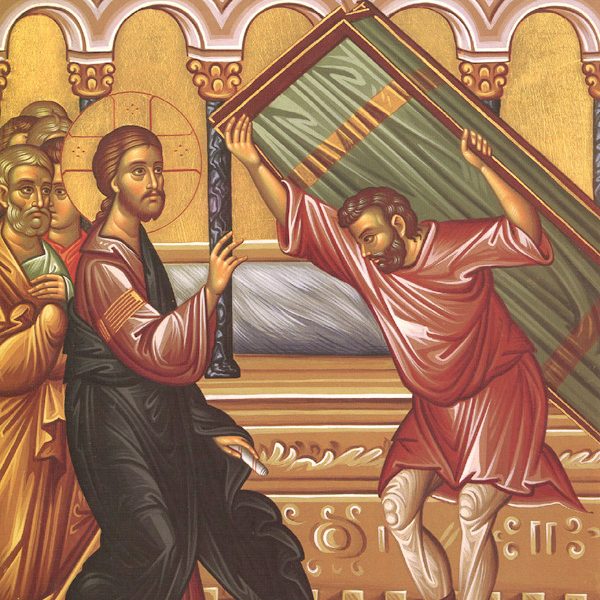
Sunday of the Paralytic–John 5:1-15
At that time, Jesus went up to Jerusalem. Now there is in Jerusalem by the Sheep Gate a pool, in Hebrew called Bethesda which has five porticoes. In these lay a multitude of invalids, blind, lame, paralyzed, waiting for the moving of the water; for an angel of the Lord went down at certain seasons into the pool, and troubled the water; whoever stepped in first after the troubling of the water was healed of whatever disease he had. One man was there, who had been ill for thirty-eight years. When Jesus saw him and knew that he had been lying there a long time, he said to him, “Do you want to be healed?” The sick man answered him, “Sir, I have no man to put me into the pool when the water is troubled, and while I am going another steps down before me.” Jesus said to him, “Rise, take up your pallet, and walk.” And at once the man was healed, and he took up his pallet and walked.
Now that day was the sabbath. So the Jews said to the man who was cured, “It is the sabbath, it is not lawful for you to carry your pallet.” But he answered them, “The man who healed me said to me, ‘Take up your pallet, and walk.’ “They asked him, “Who is the man who said to you, ‘Take up your pallet, and walk’?” Now the man who had been healed did not know who it was, for Jesus had withdrawn, as there was a crowd in the place. Afterward, Jesus found him in the temple, and said to him, “See, you are well! Sin no more, that nothing worse befall you.” The man went away and told the Jews that it was Jesus who had healed him.
In today’s Gospel, we witness the sheer power of Jesus’s word—a word that heals those who cannot help themselves. Divine grace moves toward human need without preconditions. Jesus heals not because the man earns it, but because God’s love, truth, and mercy overflow toward the broken. Yet the Gospel also shows that Jesus heals in His own time and according to the Father’s will. Physical healing, as miraculous as it is, is never the ultimate goal.
Jesus goes on to warn of the deeper judgment that comes from sin. His words are direct and sobering: “You will die in your sins unless you believe that I am he” (John 8:24). The healing of the body points to something greater—the healing of the soul through faith in Him. Christ’s mission is to fulfill the will of the Father, and the Father’s work is to bring life where there is none, to shine light into darkness, and to restore what sin has paralyzed. Jesus exercises divine authority because the Father has entrusted it to Him, and He reveals that authority through acts of healing. This is the One we are called to believe in.
From this Gospel, we learn that paralysis is not only physical. Many of us are held fast by sin, by careless habits, by spiritual stagnation. We may be moving through life, yet inwardly unable to rise. The only way to be freed from this condition is through living faith—faith rooted in our baptism, where we were born of water and the Spirit. In baptism, Christ cleanses us, raises us, and calls us into a new way of life.
The Gospel invites us to hear Christ’s voice speaking into our own paralysis. His word still carries authority. His grace still reaches out before we can reach for Him. And His call remains the same: to rise, to walk, and to live in the newness He gives.

