The Sunday of Orthodoxy gathers many themes into a single feast: the triumph of truth over heresy, the witness of the martyrs, and the steadfastness of the Church through centuries of struggle. Yet at its heart, this day celebrates something very concrete and very human—the honor due to holy icons. That meaning is especially vivid in this parish, where we are surrounded by beloved icons, some of which were carried here by parishioners who fled a modern form of iconoclasm. And it is even more fitting in a community dedicated to one of the most cherished icons of the Church: the Icon of Our Lady of Kazan.
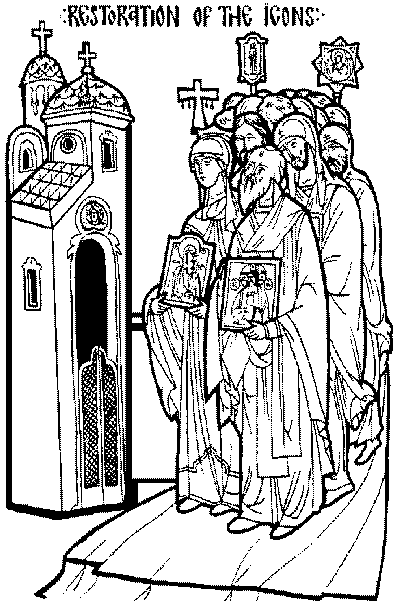
As a parish under the protection of the Mother of God, we can appreciate why an icon of the Theotokos stood at the center of the historic event that gave rise to this feast nearly twelve centuries ago. In Constantinople, Empress Theodora led a solemn procession that restored the veneration of icons to the life of the Church. At the center of that celebration was an icon of the Mother of God holding her Son—the visible reminder that God truly entered our world in human form.
Icons can become so familiar that we forget their purpose. They may seem decorative, part of the background. But today calls us to look again, to recover the meaning that can be lost through habit. As Jesus said to Nathanael, when we learn to see rightly, we begin to perceive “greater things than these”—the divine reality shining through His life on earth.
In our parish, the project to clean and restore the icons around us becomes a living metaphor. As we renew the images themselves, we are invited to renew our own understanding of what icons are and how they shape our relationship with God.
Three truths stand out.
1. Icons proclaim the Incarnation.
The hymns of this feast remind us that an icon is a visual confession that God became human. The Father, Son, and Holy Spirit are beyond all description, yet in the birth of Christ, God becomes visible. Jesus says, “He who has seen me has seen the Father” (John 14:9). St. Paul calls Christ “the image of the invisible God” (Colossians 1:15). God cannot be captured by human imagination, but God *has* taken on a human face. The true icon of God is the person of Jesus Christ.
2. Icons serve the life of prayer.
To depict Christ is to invite relationship with Him. Prayer is not merely words—it is friendship with God. Icons support that friendship. They draw the heart toward Christ, helping us to pray through Him to the Father. They are not objects of worship but windows that open toward the divine light.
3. Icons always lead us back to Christ.
Every icon, whether of Christ Himself or of His saints, points to Him. The saints are those who have reflected His light in their own lives. Their icons show us what a human life looks like when it is shaped by Christ’s love.
And so, for an icon to speak to the heart, it needs time. It asks us to return to it again and again, not analyzing but simply being present. Over time, in the quiet rhythm of the heart rather than the calculations of the mind, an icon can help nurture the inner life—our living relationship with God.

