
1 Corinthians 1:10–18 and Matthew 14:14–22–Eighth Sunday of St. Matthew
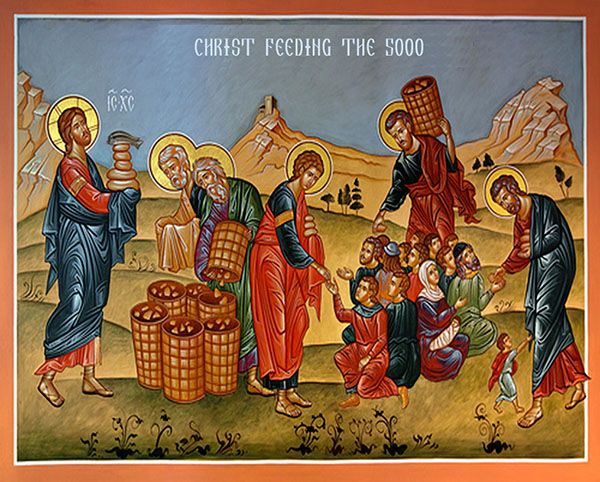
At that time, Jesus saw a great throng; and he had compassion on them, and healed their sick. When it was evening, the disciples came to him and said, “This is a lonely place, and the day is now over; send the crowds away to go into the villages and buy food for themselves.” Jesus said, “They need not go away; you give them something to eat.” They said to him, “We have only five loaves here and two fish.” And he said, “Bring them here to me.” Then he ordered the crowds to sit down on the grass; and taking the five loaves and the two fish he looked up to heaven, and blessed, and broke and gave the loaves to the crowds. And they all ate and were satisfied. And they took up twelve baskets full of the broken pieces left over. And those who ate were about five thousand men, besides women and children. Then he made the disciples get into the boat and go before him to the other side, while he dismissed the crowds.
There are moments in life when everything feels scattered—our attention, our energy, our relationships, even our hope. We try to gather the pieces, but they slip through our fingers. Paul knew this feeling well. He saw a church beginning to fracture, not because of doctrine, but because of the quiet pull of ego and preference. “I belong to Paul… I belong to Apollos…” The community was splintering into camps, each convinced of its own importance. And into that confusion Paul speaks a single, piercing question: “Is Christ divided?”
It is a question that still unsettles us. Not because we doubt Christ’s unity, but because we sense how easily our own hearts divide—how quickly we forget the One to whom we belong. The Cross stands before us as the great gathering point, the place where all our boasting falls away. Beneath its shadow, no one stands taller than another. Beneath its shadow, we remember that unity is not something we achieve; it is something Christ gives.
In the Gospel, Jesus meets another kind of fragmentation: a hungry crowd, anxious disciples, resources that seem painfully small. The disciples look at the five loaves and two fish and see only limitation. “We have only…” they say. But Jesus answers with a different invitation: **“Bring them here to me.”** What they see as insufficient, he receives as enough. What they fear will never stretch far enough, he blesses into abundance.
Christ gathers what we scatter. He gathers divided hearts, divided communities, divided hopes. He gathers our small offerings—our time, our compassion, our willingness to serve—and makes them more than they could ever be in our hands alone. The miracle of the loaves is not only about feeding; it is about communion. It is about people sitting together, receiving from one source, discovering that in Christ’s hands there is always enough.
And so we come again to the One who gathers us. We bring our scattered pieces, our limited strength, our longing for unity and peace. We bring what we have—not because it is much, but because it is his to bless. At the Table, Christ takes us, blesses us, breaks open our hearts, and gives us again to one another.
In him, we are made whole. In him, we are made one. In him, there is always enough.

