
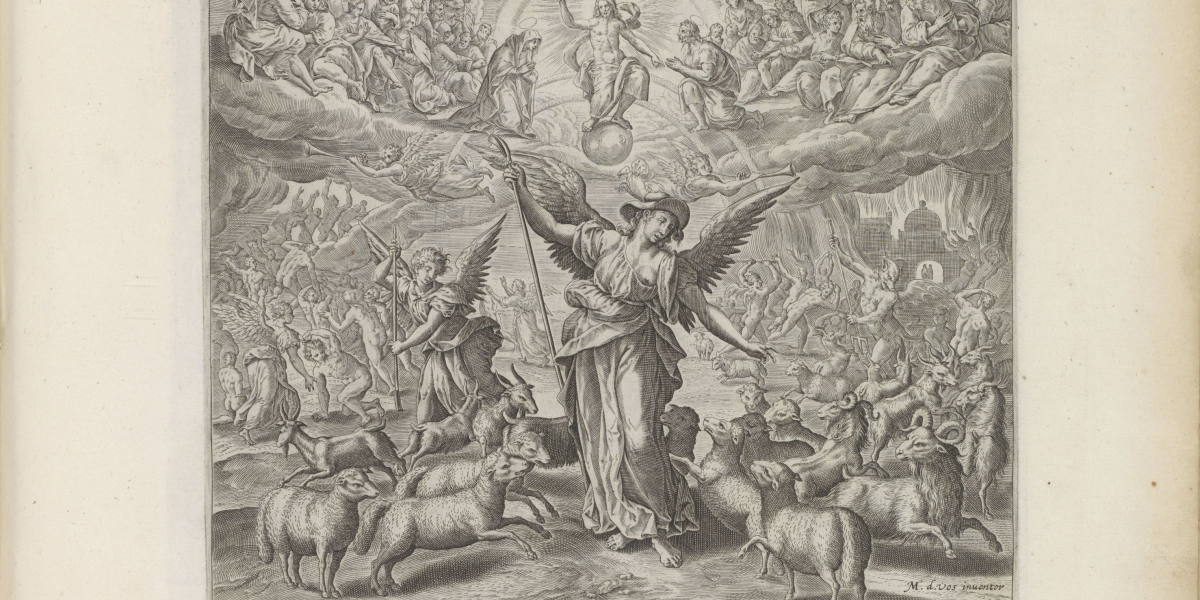
Matthew 25:31–46
The Lord said, “When the Son of man comes in his glory and all the holy angels with him, then he will sit on his glorious throne. Before him will be gathered all the nations, and he will separate them one from another as a shepherd separates the sheep from the goats, and he will place the sheep at his right hand, but the goats at the left. Then the king will say to those at his right hand, ‘Come, O blessed of my Father, inherit the kingdom prepared for you from the foundation of the world; for I was hungry and you gave me food, I was thirsty and you gave me drink, I was a stranger and you welcomed me, I was naked and you clothed me, I was sick and you visited me, I was in prison and you came to me.’ Then the righteous will answer him, ‘Lord, when did we see you hungry and feed you, or thirsty and give you drink? And when did we see you a stranger and welcome you, or naked and clothe you? And when did we see you sick or in prison and visit you?’ And the King will answer them, ‘Truly, I say to you, as you did it to one of the least of these my brethren, you did it to me.’ Then he will say to those at his left hand, ‘Depart from me, you cursed, into the eternal fire prepared for the devil and his angels; for I was hungry and you gave me no food, I was thirsty and you gave me no drink, I was a stranger and you did not welcome me, naked and you did not clothe me, sick and in prison and you did not visit me.’ Then they also will answer, ‘Lord, when did we see you hungry or thirsty or a stranger or naked or sick or in prison, and did not minister to you?’ Then he will answer them, ‘Truly, I say to you, as you did it not to one of the least of these, you did it not to me.’ And they will go away into eternal punishment, but the righteous into eternal life.”
There is a quiet longing at the heart of this passage—a reminder that the presence of Christ is often nearer than we imagine, and far less obvious than we might prefer. In today’s gospel Jesus speaks of a final sorting, a great judgment, but the real revelation is not about sheep or goats. It is about where He has chosen to dwell.
The Son of Man comes in glory, yet the story turns our gaze away from the throne. The King identifies Himself not with the powerful or the admired, but with those who live on the edges of life: the hungry, the stranger, the sick, the imprisoned. It is as though Jesus is saying, “If you want to find Me, look where the world is least inclined to look.”
What is striking in the Lord’s parable is that neither group recognized Him. Both the sheep and the goats ask the same question: “Lord, when did we see you…?” Their surprise reveals something essential. The difference between them is not theology, nor intention, nor even belief. It is the inclination of their hearts. Some lived with a readiness to respond to need, a reflex of compassion that did not require certainty or reward. Others lived turned inward, attentive only to what touched their own lives.
Jesus does not praise heroic acts. He blesses simple mercy—small, human gestures that restore dignity: a cup of water, a warm coat, a visit, a welcome. These are not grand achievements. They are the quiet habits of people who have learned to see with the eyes of the Kingdom.
And perhaps that is the invitation of this passage. Not to fear judgment, but to awaken to the possibility that Christ is already among us, waiting to be recognized in the faces we pass by too quickly. The Gospel suggests that holiness is not hidden in mystery but in plain sight, wrapped in vulnerability.
Every day offers us a chance to practice this recognition—to slow down, to notice, to respond. To let compassion become instinct. To let mercy become our way of seeing. And in doing so, we discover that the King we await is already here, in the ordinary, waiting to be met with love.
